Horror Tattoos: Between Aesthetics and Meaning – A Realist's View
What Horror Tattoos Actually Are
The word "horror" comes from the Latin horrere — to shudder, to bristle. In the tattoo world it has become a catch-all for everything dark, threatening, or macabre: skulls, demons, skeletons, decay aesthetics, creatures, horror film references.
But there is a misconception buried here: horror is not a style. Horror is a subject. And like any subject, it can be handled well or badly.
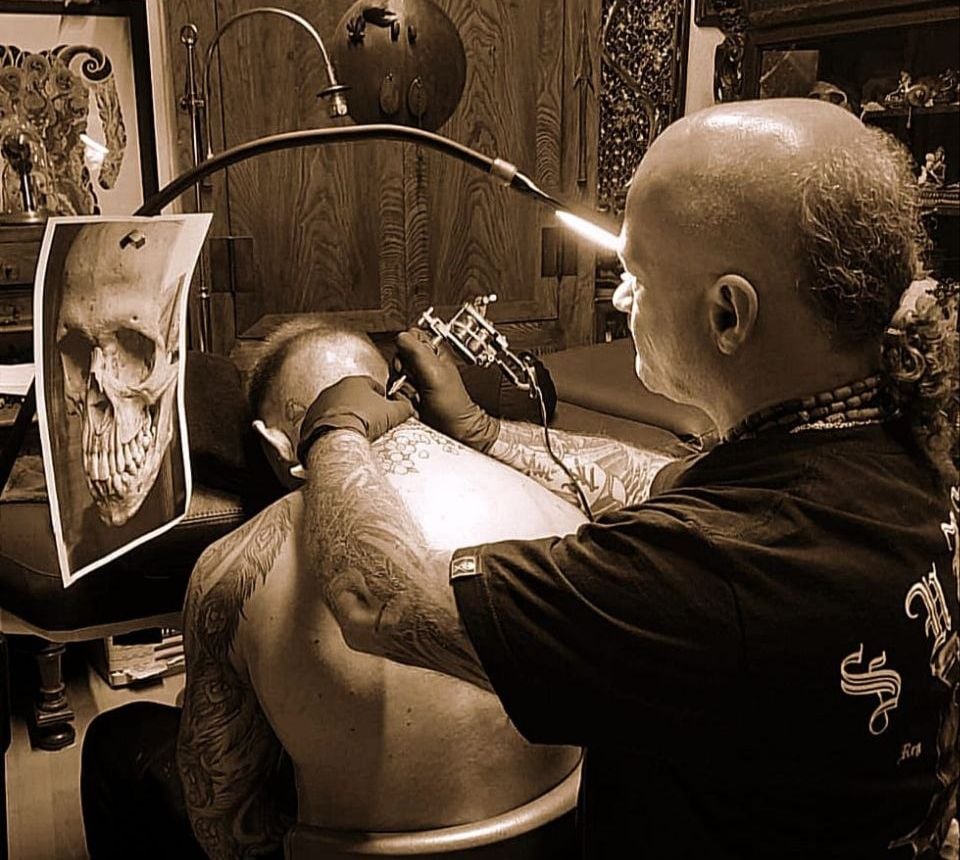
A generic skull with flames from a flash book is not a horror tattoo — it is a placeholder. A photorealisticly rendered skull where you can almost feel the bone texture, where the shadow in the eye socket is genuinely deep, where the teeth are anatomical rather than designed — that is a statement.
The Fascination With Darkness – Why People Choose Horror Tattoos
In my work I keep encountering the same pattern: the clients who choose horror motifs are rarely who you'd expect. They are doctors. Teachers. People who have lost someone. People who have survived something.
Horror tattoos speak an archetypal language. They communicate:
Confrontation with mortality — "I know I am finite. I am not hiding it."
Something survived — a dark chapter that now carries ink.
Aesthetic radicalism — the decision that beauty does not always have to be pleasing.
Protection through deterrence — an ancient, culturally deep-rooted logic (memento mori, skull-bearing warriors).
None of these reasons are trivial. And all of them deserve careful execution.
Why Horror Tattoos Need Photorealism
This is my personal conviction: a horror motif only fully unfolds its effect in realism.
Why? Because horror depends on credibility. A stylised skull does not unsettle — it decorates. A photorealistic skull where you can almost feel the bone surface, where the eye sockets are genuinely dark, where the teeth are anatomical not designed — that pulls the eye in and holds it.
The same applies to animals in a horror context: a scorpion rendered flat and schematic is a sign. A scorpion with real surface structure, a highlight on the chitin plate, a pose that implies motion — that thing lives.
Photorealism makes horror real. And only what is real has power.
The Line Between Horror and the Generic
The greatest danger in horror tattooing is cliché. The world is full of mediocre skulls, generic demons, copied horror film masks. That is neither art nor statement — it is wallpaper.
I decline projects where the motif has no story. Not from arrogance — but because a tattoo that means nothing becomes nothing. Skin is not a sketchbook.
What I require:
An idea, not just an image.
A reason why this motif belongs on this person.
Willingness to develop the motif together — not simply to message a flash image.
When those things are present, something emerges that will still be relevant in ten years.
Examples From My Work
Skull and Scorpion (forearm): The client came with two themes — his star sign and an affinity for death as an aesthetic concept. We combined both into one piece: skull and scorpion, black and grey realism, one session. Three hours. No touch-up.
Skull on the hand: One of the most demanding projects I take on. The hand is a challenging surface — skin that moves, stretches, ages. And at the same time, no placement is more visible. This skull with geometric lines across the wrist was the result of a deep conversation. Not about aesthetics — about control and impermanence.
Horror Tattoos in Wiesbaden – What to Know
Choose an artist who genuinely knows this subject. Not every realist is suited to horror. Look at the portfolio carefully: are there pieces with actual dark atmosphere — not just a dark motif?
Bring an idea, not a finished image. The best horror tattoo is not a screenshot from the internet. It comes out of a conversation.
Think about placement. Horror motifs carry visual energy. That energy reads differently on different parts of the body.
Horror Tattoos at Tattoo Jaga, Wiesbaden
Tattoo Jaga, Walramstraße 4, 65183 Wiesbaden. Black and grey realism. No flash, no templates. Evgenij Korsun works with horror motifs when they carry a story — and he develops that story together with the client.